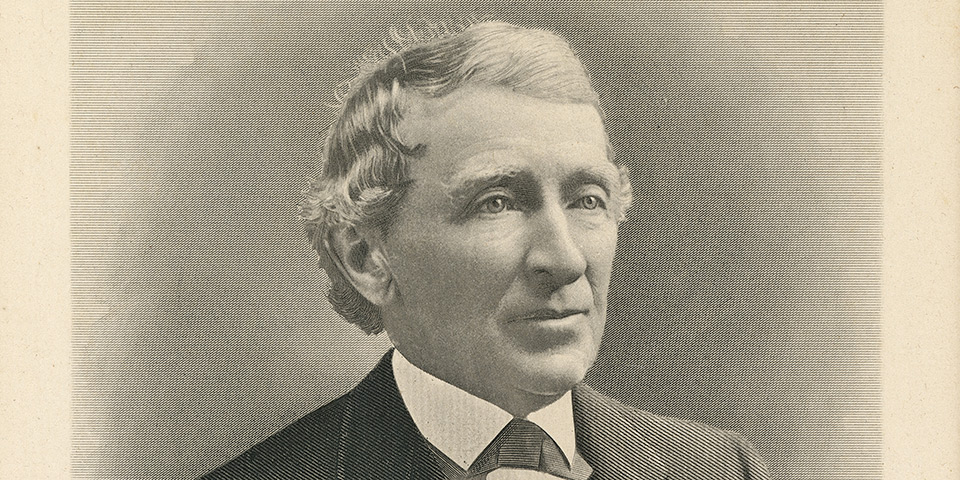
Jesse Weldon Fell was born into a Quaker family in Pennsylvania in 1808. In the 1830s he emigrated to central Illinois, which was then the frontier, and began investing in farmland. Over the course of his life he worked as a schoolteacher, lawyer, arborist, and publisher while winning and losing huge fortunes in land speculation schemes. In addition to his vast real estate holdings and fundraising for public works, he is credited as a founder of Illinois State (Normal) University, the Illinois Soldiers’ Orphans Home (later renamed the Illinois Soldiers' and Sailors' Children's School), and the Illinois State Reform School, as well as Livingston County, DeWitt County, and several central Illinois towns, including Normal, Clinton, Towanda, Dwight and Pontiac. He also attempted to secure the Illinois Industrial University (now University of Illinois Urbana-Champaign) for Bloomington but lost the bid to Urbana. Fell owned, edited, and wrote for two local newspapers at various points in his career: the Bloomington Observer and McLean County Advocate and the Bloomington Intelligencer (now the Pantagraph). During the 1850s he was instrumental in locating the junction of the Illinois Central and Chicago-Alton Railroad lines at what was then known as North Bloomington, facilitating the later establishment of ISNU and the modern-day town of Normal at that location.
Due to his local prominence, philanthropy, and outspoken political views, Fell’s boosters urged him to run for public office several times, but he always declined. While working as an itinerant lawyer in his youth, Fell crossed paths with Abraham Lincoln and future Supreme Court justice David Davis, who were also practicing law in central Illinois at the time, forming two lifelong friendships. Always a staunch opponent of slavery, Fell became increasingly politically active throughout the 1850s, helping to organize the Illinois Republican Party and serving as the corresponding secretary of its Central Committee. He proposed the 1854 Lincoln-Douglas debates and was a driving force behind Lincoln’s presidential campaign, transforming him from an obscure candidate into a front-runner. Fell famously solicited Lincoln for an autobiography during the fall of 1859 and Lincoln eventually complied with a short sketch of his life which Fell immediately sent off for publication in the Chester County (Pa.) Times. The article was picked up across the nation, introducing thousands of voters to Lincoln’s humble beginnings.
In June 1861, two months after the advent of the Civil War, Fell traveled to Washington, D.C. with ISNU President Charles Hovey to meet with Lincoln about raising a regiment comprised of students and faculty from the university. Upon their arrival at the capital they journeyed with a great group of civilians 25 miles southwest with the aim of watching the Union Army route the Confederates at Manassas. The resulting bloodbath – the First Battle of Bull Run – caught all by surprise. Hovey reportedly joined the fighting, while Fell, a committed pacifist, assisted the wounded. Hovey thereafter received a commission from Lincoln as a colonel and returned to Normal to raise Illinois’ 33rd Infantry Regiment, colloquially known as the Teacher’s Regiment.
Fell also returned from Washington determined to contribute to the Union’s cause. Though at the time 54 years old, he began putting his affairs in order for a protracted absence with the aim of serving in the war effort. At Fell’s prompting, Lincoln wrote to Secretary of War Edwin Stanton on December 23, 1861, directing that Fell receive a commission as a paymaster in the Union Army. On March 29, 1862 he wrote again, reiterating he did “really wish Jesse W. Fell, of Illinois, to be appointed a Paymaster in the Regular Army, at farthest, as early as the 1st of July, 1862. I wish nothing to interfere with this, and I have so written as much as two months ago, I think.” Fell’s commission finally came through on June 30th and he soon after decamped to Lexington, Kentucky to begin his service accompanied by his daughter Eliza’s fiancé William O. Davis as a clerk.
Over the next 18 months Fell’s work would take him to cities across Indiana, Ohio, Kentucky, and Tennessee. Despite traveling hundreds of miles between military encampments, some quite close to the front lines, Fell’s Quaker faith and “fixed principle of trusting men” prevented him from bearing arms. In September 1862 Fell swapped clerks with more experienced paymaster William Smith. Fell’s new clerk, Rodney Smith, was William’s brother and when Fell gave up his commission in December 1863 Rodney took over the position.
After returning to Normal, Fell resumed his neglected businesses, including the cultivation and sale of ornamental trees and shrubs. Along with David Davis and other wealthy Bloomington residents, he contributed funds for the establishment of the Illinois Soldiers’ Orphans Home in 1865 and advocated for the racial integration of ISNU’s K-12 “model school” in 1867. Later, Fell invested in an unsuccessful venture to create a “college for soldiers and their sons” at the Western Union College and Military Academy in Fulton, Illinois. His final years were much occupied with tending to his extensive real estate portfolio. Jesse Fell died on February 25, 1887 and is buried at Evergreen Memorial Cemetery in Bloomington.