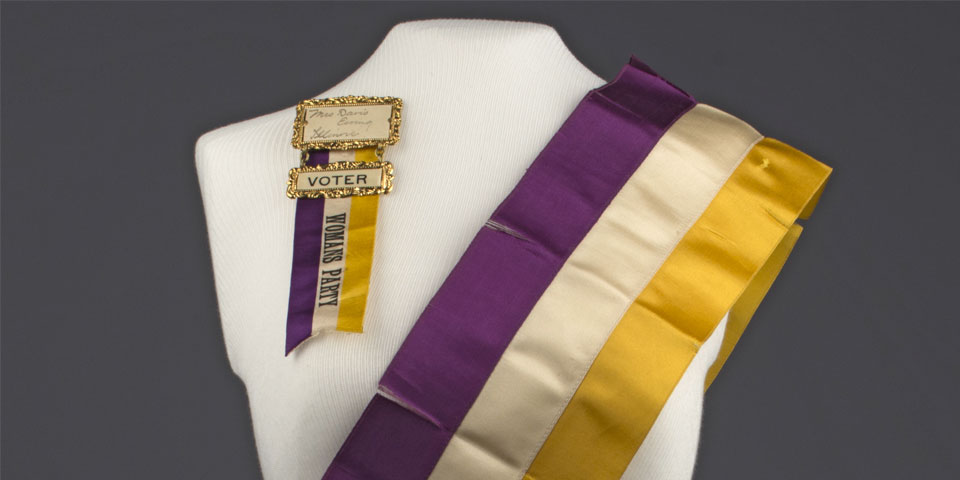
Hazle Buck Ewing Women’s Suffrage Collection
Hazle Buck Ewing passionately supported many causes over her lifetime. She joined the women’s suffrage movement in 1915 and devoted the next four years to working with local, state, and national leaders to help secure voting rights for women by writing letters and articles, organizing and attending conferences, and providing financial support. A lifelong member of the Bloomington League of Women Voters, Hazle voted in every election from 1920 until, in old age, she became too ill to leave her home.
View the Hazle Buck Ewing Women’s Suffrage Collection
Sunset Hill Architectural Records
Davis Ewing took many photographs of architecture in the countries he visited with Hazle and their adopted son Ralph during their 1924-25 world tour as inspiration for a new home he intended to build for his family. After returning to Bloomington, he hired Associates of A. L. Pillsbury, Architect to take on his vision. Phillip Hooton was the architect assigned to the project and the John Felmey Company served as the contractor. Construction began on March 1, 1928 and the Ewings moved in in September 1929.
Hooten, working closely with the Ewings, incorporated French-inspired detailing and English functionalism into the Channel Norman-style residence. The Ewings used reclaimed materials, such as bricks from an abandoned brewery, artificially weathered limestone and timber, and modern concrete supplied by Davis’ company to construct their dream home, which they named “Sunset Hill” in honor of landscape architect Jens Jenson who designed the curving pathway where both sunrise and sunset could be viewed.
Davis lived in the home for less than a year before the couple divorced in 1931. Hazle and her companion Julia Fairfax Hodge occupied Sunset Hill for the remainder of their lives. Upon her death, Hazle bequeathed her home and its contents to the Illinois State University Foundation. Now known as the Ewing Cultural Center, the manor and its grounds host a number of events throughout the year, including the Illinois Shakespeare Festival, exhibits, tours, and private events.
View the Sunset Hill Architectural Records
William “Whig” Ewing Collection
William Gillespie “Whig” Ewing (1839-1922) was an uncle to Davis Ewing and the younger brother of James, Davis’ father. William’s early life, education, and development as an attorney closely resembled James’ path, however while the latter lived all but his earliest childhood years in Bloomington, William spent the first half of his professional career in the riverine community of Quincy, where he soon made a name for himself as a skilled and dogged prosecutor.
After moving to Chicago in 1882, William established a law practice with his and James’ youngest brother Adlai. Four years later William received an appointment from President Grover Cleveland to become a federal judge for Illinois’ Northern District. William capped his legal career with an elected position as Cook County superior court judge from 1892-1898. An impassioned convert to Christian Science, he spent the next 12 years lecturing on that topic domestically and internationally. William retired in 1910 and died several years later at the age of 82.
This collection, donated to Ewing Cultural Center by descendants of Adlai Ewing in 2025, documents William’s legal career and family ties with letters, certificates, photographs, and curious pieces of realia, including a mechanical pencil and coin purse which family lore maintains were given to the Ewings by Abraham Lincoln and an engraved cane presented to William by the grateful citizens of Collin County, Texas following his successful prosecution of Steven Ballew for the murder of James Golden.